This is the first of three features that I will be doing this pre-season regarding an analysis of fantasy Wide Receivers.
In the two future segments I will analyze Sophomore Wide Receivers (from the Class of 2025) and look closely at what I call the QB-to-WR Index.
In this feature, I will attempt to look at the empirical receiving data from 2025 (in terms of targets, receptions and fantasy points) to help build a model (or at least a starting point) for ranking the fantasy wide receivers headed into 2026.

More specifically, this feature is built around a number of top-50 charts. My goal is to use the data represented in these tables to begin a guided tour that will hopefully get us to our destination: an initial ranking of fantasy wide receivers.
The charts include the final 2025 rankings of wide receivers in the following categories: Fantasy Points, Receptions, Targets, Team Share, Conversion Rate, and Fantasy Points Per Target.
Note that the tables below reference the 2025 team for which each player played last season.
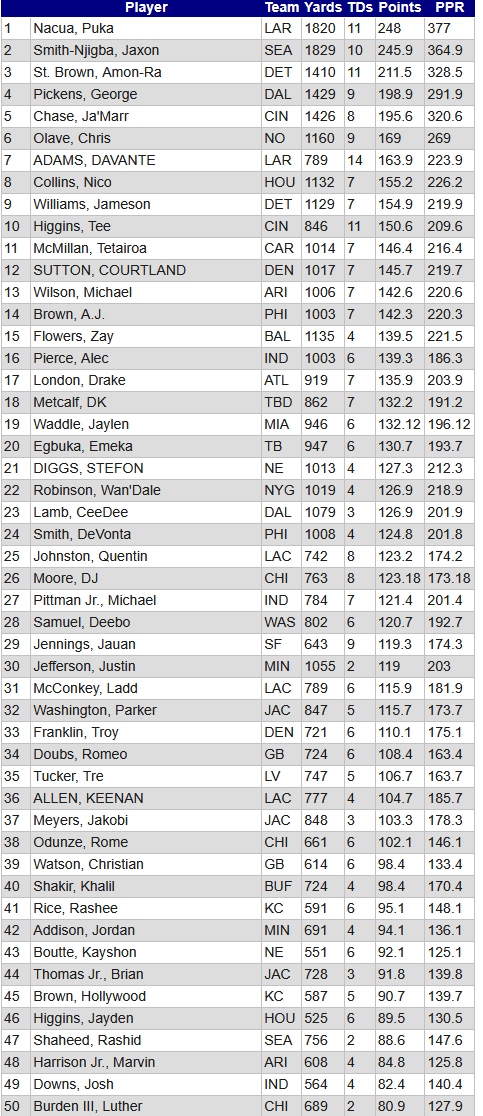
Lets start by simply looking at the wide receivers who scored the most points in fantasy in 2025. Note that the point totals listed below represent both standard scoring (0.1 point for each yard rushing/receiving and 6 points per touchdown) as well as point per reception (PPR) -- standard PLUS one bonus point per reception totals. The data is sorted by Standard Scoring.
Fantasy Points
Observations:
There is nothing truly earth-shattering here, as when we look at the total numbers at a high level, we simply see the top 50 fantasy WRs from last season. Obviously most of these players will be high in the 2026 rankings with the presumption that they will have another successful fantasy season. What jumps out immediately is how closely Puka Nacua and Jaxon Smith-Njigba (JSN) finished atop the list of fantasy receivers in 2026. Puka was ranked highly headed into the 2025 season, but JSN was viewed more as a fringe/borderline WR1/WR2 at this time last season. Both exceeded expectations and both will be among the first WRs drafted in the vast majority of fantasy leagues in 2026.
While many saw Ja'Marr Chase, who was almost universally ranked as the #1 WR in fantasy heading into last year's campaign, as something of a bust, it is worth noting that even with a lackluster production per target rate (see below), his sheer volume (see also below) STILL resulted in him finishing a s top 5 WR in fantasy. There were also a number of surprise players such as Jameson Williams, Tetairoa McMillan, Michael Wilson, Alec Pierce, and Emeka Egbuka who all posted start-worthy numbers -- that is, finished as at worst a WR2 in 12-team leagues -- but were largely overlooked last year in fantasy drafts.
Some of the more disappointing players were Malik Nabers, Justin Jefferson, CeeDee Lamb and Brian Thomas Jr. who were typically drafted with high selections in fantasy drafts yet seriously under-performed (in many cases due to injury).
Receptions
Observations:
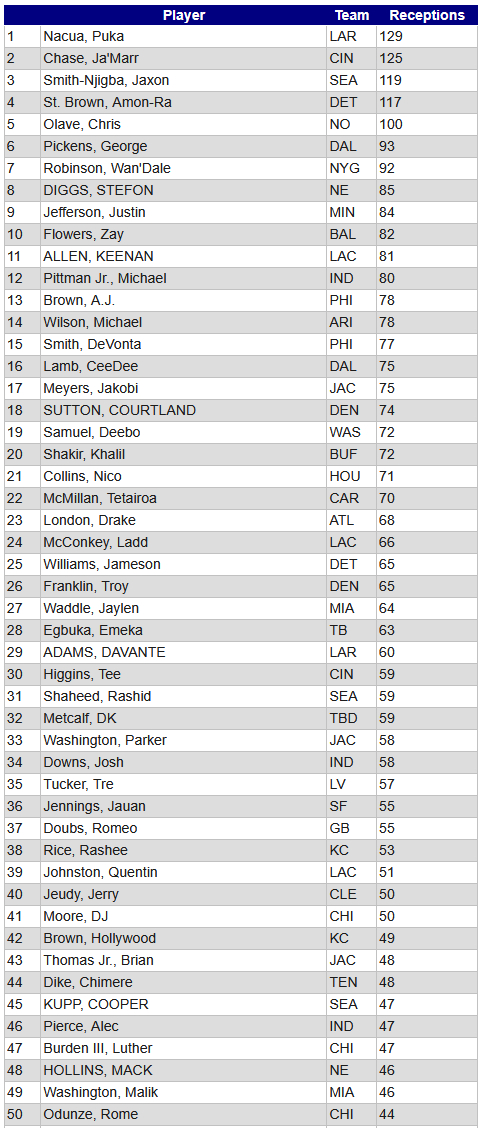
Receptions are key because not only do they represent opportunities for yards and TDs -- but they also directly correlate to fantasy points in PPR (Point Per Reception) formats.
A good example of the variation in the two formats is Alec Pierce who finished as the 16th fantasy WR in standard scoring (thanks to a highly productive number of fantasy points per target) but would have finished as a middling WR3 in PPR formats due to a relatively low volume of targets. On the flip side of the coin we have Justin Jefferson who WAY under-performed as our fantasy WR30 in standard scoring (thanks to a ridiculously low 2 TD receptions) but was still a WR2 in PPR formats thanks to his decent number of catches (84), which was admittedly still low for him.
What does this mean?
Make sure you look closely at the scoring rules in your league. If it is PPR then players like Jefferson and Amon-Ra St. Brown are even more valuable. Of course, guys like Puka, JSN and Chase are even MORE valuable in PPR formats -- I am talking valuable enough to draft in the top 3-4 picks as opposed to waiting until later in the 1st round. Even a receiver like Chris Olave is worth picking no later than early in the 2nd round in PPR formats.
Targets
Observations:
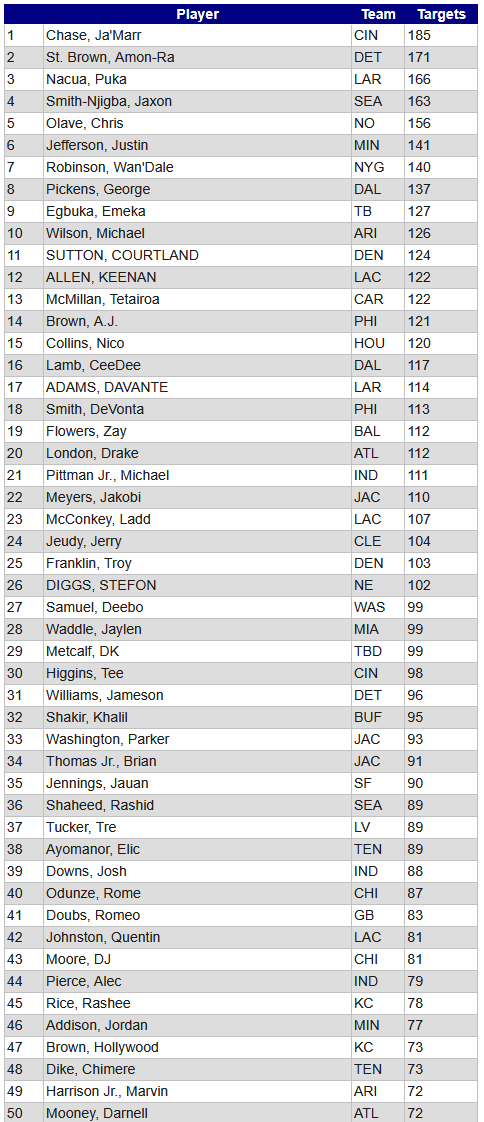
In a way, targets are even more interesting numbers to look at than receptions. I think of a reception as being the successful outcome of a target. Targets represent opportunities.
The mantra in fantasy, of course, is not to assume that opportunity leads to production. While that is also true with the targets, of course, it makes sense that there is a direct correlation to receivers who were heavily targeted in the passing game with those who had strong fantasy seasons.
Justin Jefferson, Keenan Allen, Michael Pittman Jr., Jakobi Meyers, Ladd McConkey, Jerry Jeudy, and Troy Franklin are the only receivers among our top 25 most-targeted, who did NOT also make the top 25 list in fantasy points scored. Funny enough, that is actually a higher number than usual. In 2024, for example, we only had three of the top-targeted WRs who did not finish among the top fantasy scorers.
From that perspective, these players had the most disappointing seasons of all, because the opportunities were there. Moreover, since they failed to produce on the volume of opportunities with which they were presented, there is a chance that they will see a significant decline in opportunities (targets) this year. Take Jerry Jeudy, whose healthy 104 targets did not result in enough production to even place him among the top 50 WRs in standard fantasy scoring. His situation may be unique given his huge volume with minimal results (and admittedly horrific QB situation), but the point must be made that receivers who are targeted a lot (and may even catch high percentage of their targets) may not necessarily be fantasy studs.
Team Share
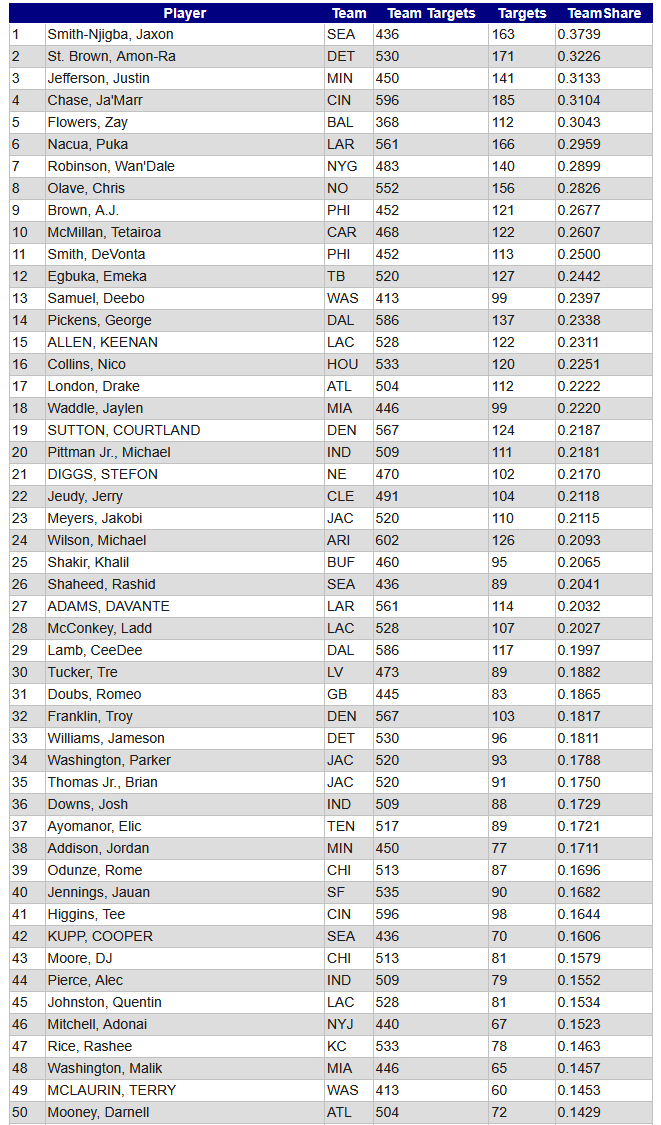
Observations:
I find this chart to be more interesting than necessarily useful from a fantasy perspective. What it does is emphasize how important that a given receiver was to his team in terms of the percentage of targets that went his way.
What this does is emphasize not only which receivers were the favorite targets of their respective teams -- but which ones became the apple's eye of their quarterback.
It is not surprising to see at the top of the list JSN. What is a bit surprising is That Jefferson (despite his overall disappointing season) still finished 3rd among WRS with a team share of over 31%, which defies the perception that he was under-utilized in 2025. Rather, he was largely the victim of terrible QB play. A couple of interesting names that made the top 10 list here include Zay Flowers and Wan'Dale Robinson.
I suppose the value from a fantasy perspective here lies in identifying those teams which may evolve into a more pass-friendly offense in 2025 or whose QB situation may be better.
I'll look at that more closely in a future installment on Taking a Look at the QB-to-WR Index. So be on the lookout for that segment in the next week or so.
Conversely, be careful to look closely at teams that added immediate reinforcements -- or players who have moved on. For example, DJ Moore goes from a crowded receiving room in Chicago to be more of a big fish in Buffalo -- and with Josh Allen slinging him the ball.
Conversion Rate
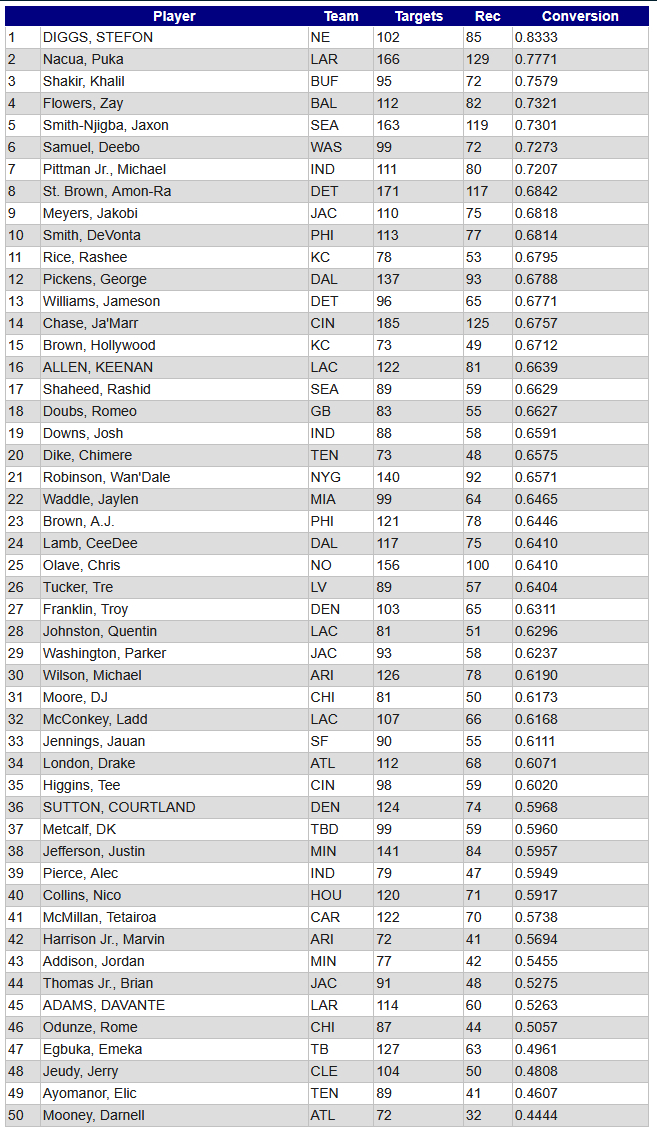
Observations:
Think of this as the list of receivers with the best batting average. That is, the receivers who converted the greatest percentage of their at-bats (targets) into hits (receptions). For this exercise, I have excluded players who did not have at least 70 targets. I must admit that I was rather surprised to see the top 10 list. It is especially interesting that Diggs ranked #1, especially considering that as of this writing he remains unemployed. Of course, his job situation (as we all now) is a productive of his off-field activity (and questionable behavior) rather than his always fantastic on-field productivity.
Shakir's presence at #3 is noteworthy but not especially surprising as he has always converted a very high volume of targets into receptions. JSN and Puka aren't as surprising given their fantastic seasons, but their presence in the top 5 here -- especially given their ridiculous volume -- is yet another sign that they can BOTH be viewed as THE MAN headed into 2026.
Fantasy Points Per Target
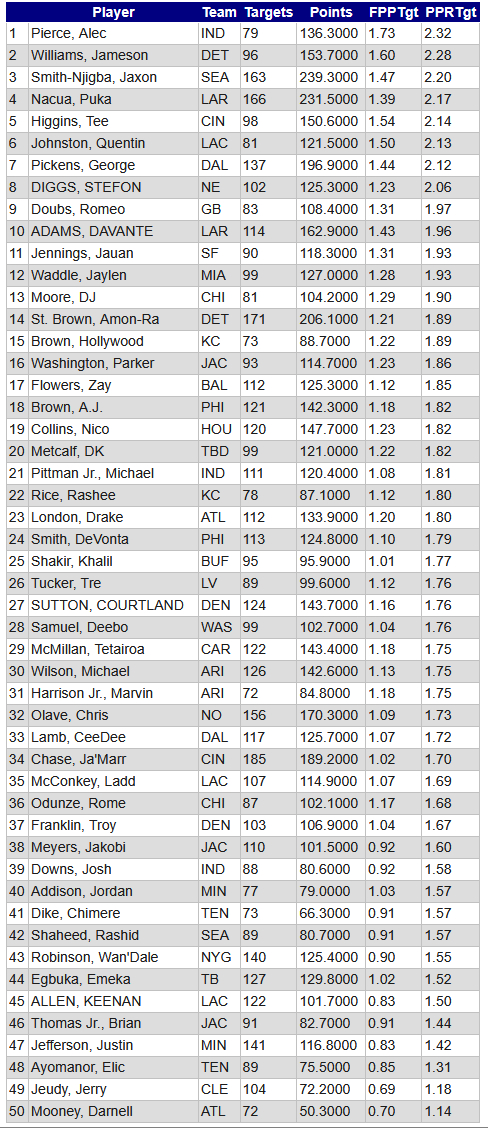
Observations:

The list above is again for a minimum of 70 targets. The Points Per Target value was rounded to two digits to the right of the decimal, but all sorting was performed prior to the rounding -- and no two players had an identical value prior to the rounding. That is, there were no ties despite the identical values listed above -- and the players are all listed in the correct order. Pierce's ranking at #1 (as we noted earlier) is a testimony to what a big play threat he was in 2025. Proceed with caution with him in 2026, though, as that sort of high-flying production is difficult to maintain.
After clarifying all that, I must say that this is one of my favorite statistics when looking at fantasy wide receivers as it truly measures which players made the most (fantasy points) of the opportunities presented to them (targets). The key to identifying fantasy relevance is to identify which players appear on this Fantasy Points Per Target chart as well as the Total Targets chart. This will present you with the list of players who operated at a high fantasy level due to both volume and production.
Using such a formula gives us the following players who had the highest combined score on both charts:
1A. Jaxon Smith-Njigba
1B. Puka Nacua
3. George Pickens
4. Amon-Ra St.Brown
5. Davante Adams
6. AJ Brown
7. Jameson Williams
8A. Stefon Diggs
8B. Nico Collins
10A. Tee Higgins
10B. Ja'Marr Chase
12. Zay FLowers
13. Chris Olave
14. Courtland Sutton
15A. Jaylen Waddle
15B. Michael Wilson
17A. Michael Pittman Jr.
17B.DeVonta Smith
17C. Tetairoa McMillan
20. Drake London
21. Alec Pierce
22. Jauan Jennings
23A. Quentin Johnson
23B. Ladd McConkey
25A. Parker Washington
25B. DK Metcalf
25C. CeeDee Lamb
28A. Romeo Doubs
28B. Wan'Dale Robinson
30A. Emeka Ebuka
30B. Justin Jefferson
32. Deebo Samuel
33. DJ Moore
34A. Khalil Shakir
34B. Keenan Allen
36. Jakobi Meyers
37. Hollywood Brown
38A. Tre Tucker
38B. Troy Franklin
40. Rashee Rice
41. Jerry Jeudy
42. Rome Odunze
43A. Josh Downs
43B. Rashid Shaheed
45A. Marvin Harrison Jr
45B. Brian Thomas Jr
47A. Jordan Addison
47B. Elic Ayomanor
49. Chimere Dike
50. Darnell Mooney
Obviously this is far from scientific and fails to take other key factors (such as injuries, possibility of unusually bad/good season, new team, etc.) into account. But I think it represents an interesting and defendable baseline.